JOURNAL
Waxed Canvas: A Material Designed to Last
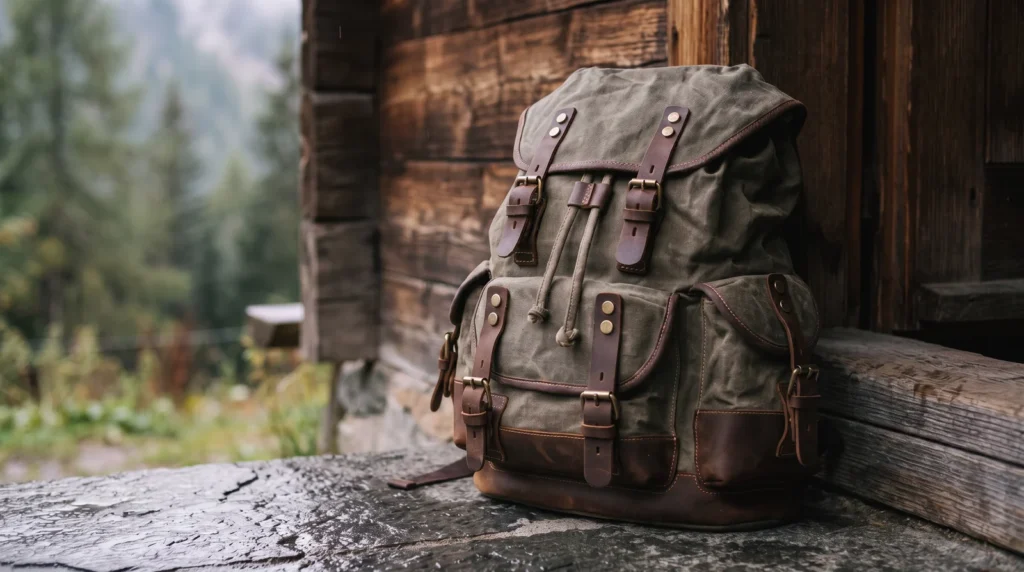
Long before technical membranes existed, sailors and workers exposed to harsh weather were already looking for ways to make cotton canvas more protective. The principle is simple: a tightly woven canvas is treated with a wax-based finish that works its way into the fibers. Water then beads more easily on the surface instead of immediately soaking into the fabric.
Even today, waxed canvas retains something truly distinctive: it does not try to hide the passage of time. It lets it show.
A Dense Canvas Protected by Wax
Waxed canvas begins with tightly woven cotton. This density gives the fabric its structure and durability, while the wax complements this foundation by enhancing its resistance to moisture.
Depending on the manufacturer, the finish may combine different waxes, oils, and protective agents. It is applied so that it works into the fabric rather than forming a rigid film on the surface. This allows the canvas to retain its matte appearance, natural texture, and distinctive feel.
It is nothing like a smooth or rigid synthetic material. Its surface remains dynamic: it creases, develops tonal variations, and softens in certain areas. Its appearance naturally evolves with friction and the conditions in which it is used.
Water-Resistant, Never Invulnerable
The waxed finish helps the canvas repel water more effectively during rain showers and everyday use. This provides valuable protection for a bag, but it does not guarantee complete waterproofing.
Under prolonged or heavy rain, when exposed to water under pressure, or as the finish gradually wears over time, moisture may eventually penetrate the fabric. Seams, closures, and openings also remain naturally more vulnerable areas.
To protect a laptop, documents, or any other delicate items, an inner protective sleeve remains the best precaution when conditions become particularly harsh.
The Marks Are Part of the Material
Waxed canvas does not age in a perfectly uniform way, and that is precisely what gives it its character.
The wax may shift or gradually wear away in certain areas, creating lighter or darker tonal variations across the surface of the canvas.
These marks are not necessarily flaws. They are part of the natural behavior of a waxed finish. Over time, the areas handled most often—the flap, corners, folds, and shoulder straps—typically become the most expressive.
Two bags that start out identical will therefore never tell quite the same story.
A Material That Can Be Maintained
The wax gradually wears away, especially in high-friction areas and along frequently flexed folds. This is completely normal. As the finish weakens, the canvas may appear lighter or become less effective at repelling water.
One of the key advantages of this material is that it can be maintained. With a suitable rewaxing product, the finish can be renewed and some of its protective properties restored.
This approach particularly resonates with us: rather than seeing signs of use as the end of an object’s life, it can be cared for and kept going for longer.
Why Norvaed Chose Waxed Canvas
At Norvaed, we value objects that gain character and presence over time.
From the outset, waxed canvas stands out for its matte appearance, visible texture, and densely woven construction. Over time, it evolves: creases begin to form, tonal variations emerge, and the most frequently used areas gradually become more distinctive. It accompanies both everyday life and spontaneous departures, without erasing the marks they leave behind.
It requires a little more care than a synthetic fabric: it does not respond well to harsh washing or strong sources of heat, and its appearance will naturally change with use. But this evolution is not a compromise. It is part of its beauty.
Waxed canvas is not made to stay new. It is made to age well.
Key Takeaways
Tonal variations, creases, and areas of wear are all part of the natural behavior of waxed canvas. However, if water no longer beads on the surface and the fabric begins to absorb it quickly, rewaxing may be necessary.
Pour aller plus loin
La toile cirée s’associe naturellement au cuir Crazy Horse, un cuir pleine fleur qui développe une patine unique au fil du temps. Pour préserver durablement ces deux matières, découvrez également comment entretenir votre sac en toile cirée et cuir.
Retrouvez notre sélection de sacs à dos vintage et de sacs de voyage vintage, conçus en toile cirée et cuir.