
JOURNAL
Crazy Horse Leather: A Leather That Evolves With You
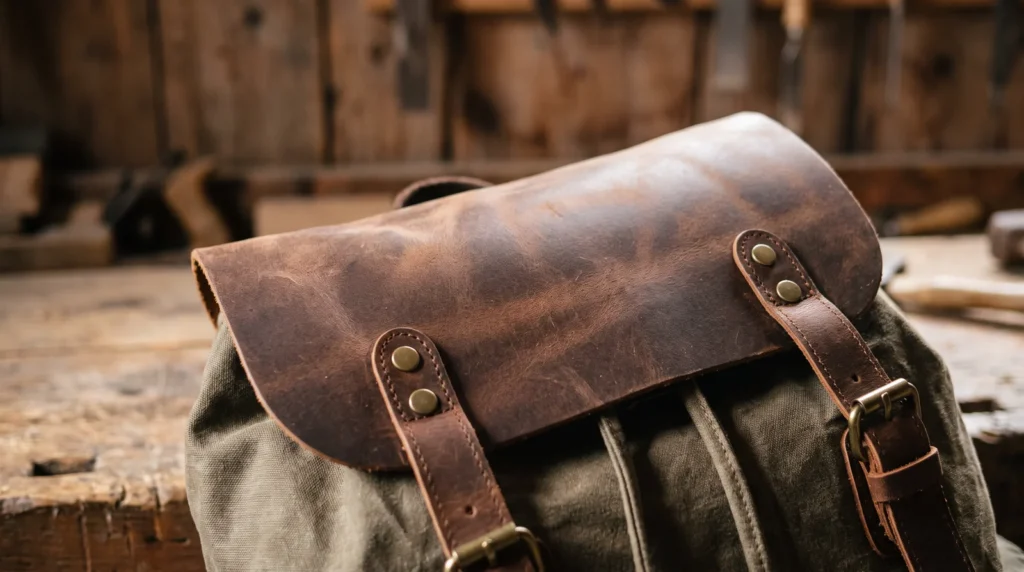
Crazy Horse leather is not meant to remain perfectly uniform. From the very first uses, it responds to movement: a fold, pressure, or light friction can cause subtle changes in tone. Over time, these variations blend together, giving the leather a character and presence of its own.
It’s a leather made to live, not to stay unchanged.
What “Crazy Horse” Really Means
Despite its name, Crazy Horse leather generally does not refer to horse leather. It is a term commonly used for leathers finished with a rich blend of waxes and/or oils to create a distinctive effect known as effect pull-up.
This term does not, on its own, guarantee the origin of the hide, its thickness, the tanning process used, or the degree of surface correction. These characteristics vary depending on the leather and the manufacturer. Above all, the name describes a visual behavior: a material that reacts to pressure, develops tonal variations through use, and gradually acquires a patina.
The exact origin of the term “Crazy Horse” is not clearly established. It is often associated with the world of saddlery, but what matters most lies elsewhere: in the way the leather evolves in the hands of the person who carries it.
The pull-up : Why Leather Changes Color
In pull-upeffect, the finish is rich in waxes and oils. When the leather is bent, pressed, or lightly scratched, these oils and waxes shift slightly. The affected area may then appear lighter: this is known as the pull-up effect. pull-up.
A light scratch does not necessarily indicate deep damage to the leather. It often reflects a variation in the finish. By gently massaging the area with the pad of a clean finger, or with a soft, dry cloth, the waxes can redistribute and visually reduce the mark.
Not all marks will disappear completely, nor do they need to. Some will gradually blend into the leather’s overall patina over time. A deep cut or tear, however, is genuine damage to the material and should be treated appropriately.
A Material That Bears the Marks of Use
Its feel can be supple and slightly waxy, while its appearance varies depending on the formulation used. Its surface retains the memory of folds, friction, and the habits of the person who carries it.
Over the months, the leather may develop greater depth, show tonal variations in the areas most frequently touched, or acquire a subtle sheen. This evolution is never exactly the same from one bag to another. It depends on light, humidity, everyday handling, and the care given to the material.
That is also part of its charm: two bags that look similar at first will never develop exactly the same appearance after a few years.
What Sets It Apart from Other Leathers
The main difference lies in the finish. Pigmented leather, often protected by a more uniform finishing layer, is designed to maintain a stable, consistent appearance. Leather with a pull-upfinish, on the other hand, allows more of the tonal variation and signs of use to remain visible.
This does not automatically make one type of leather better than another: they simply reflect two different approaches. One prioritizes uniformity, while the other embraces a more expressive material whose appearance evolves over time.
Crazy Horse leather is therefore ideal for those who appreciate objects that carry the subtle marks of the journeys and experiences they have been part of.
Why Norvaed Chose This Leather
At Norvaed, we value materials that develop more character with use. Crazy Horse leather gives our bags rich tonal variations and a patina that gradually develops over time, rather than a surface that remains unchanged.
Paired with waxed canvas, it creates a robust, characterful combination designed to accompany everyday life, spontaneous departures, and the marks they leave behind.
We create the bag. You give it its story.
Pour aller plus loin
Le cuir Crazy Horse se marie naturellement à la toile cirée, une matière résistante pensée pour durer. Découvrez également comment entretenir un sac en toile cirée et cuir pour préserver ses matières et sa patine.
Retrouvez notre sélection de sacs à dos vintage et de sacs de voyage vintage, conçus en toile cirée et cuir.